Your cart
Your cart is empty
Start with the essentials for training at home.
Best sellers
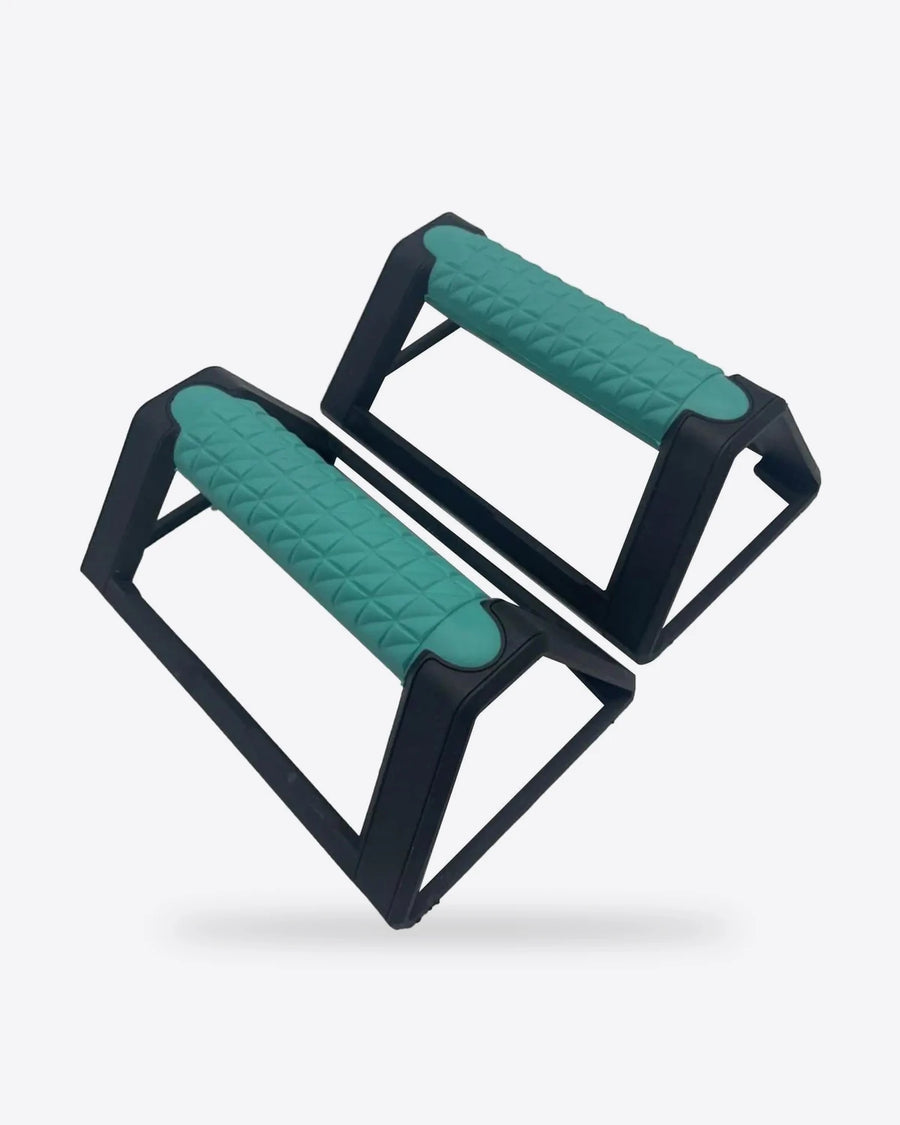
Parallettes keep your wrists straight and add range of motion to push-ups, the L-sit, the handstand and the planche.
Low parallettes work for push-ups, the L-sit and learning to balance. High parallettes give your legs room to pass under and add range of motion: they suit dips, deep push-ups and skill work. Start from the exercise you do most often.
Wood feels warm and pleasant to hold, and it slips very little when your hands sweat. Metal is thinner and more impact-resistant. Push-up bars often have a non-slip grip. Choose the material that gives you the confidence to hold a position for several seconds.
Look at the width of the base and whether it has non-slip feet. Parallettes that move on the floor stop you holding an L-sit or a balance. Place them on a hard, flat floor or on firm tiles, and check they don't tip before every set.
For push-ups alone, push-up bars are enough. For the L-sit, the handstand and the planche, get parallettes, low or high depending on your level. They're easy to store and to take to the park. If you want to do dips on them, choose a high model.
Low ones to start push-ups, the L-sit and balance work. High ones if you want to do dips, deeper push-ups or swing your legs through under your hands. Many people start low, then add a high pair when they work on skills. The two heights complement each other.
Push-up bars are mainly for push-ups: they keep your wrists straight and add range of motion. Parallettes go further: L-sit, handstand, planche, and dips on the high models. If you only do push-ups, push-up bars are enough. If you're aiming for skills, get parallettes.
Push-ups, the L-sit, the tuck planche, the handstand and leg swing-throughs. With high parallettes, you add dips and deep push-ups. Start with push-ups and the L-sit to get your wrists and shoulders used to the position, then move on to balance skills.
Wood feels warmer and gives your hands a good grip, which helps on held positions. Metal is more compact and copes better with knocks and damp. For indoor training and static holds, wood is a good choice. Outdoors, metal needs less looking after.
Yes, if your floor is slippery or fragile. A firm mat stops your parallettes sliding and protects your wooden floor. Avoid a mat that's too soft, though: it makes balance positions unstable. Dense, thick foam tiles do the job for most exercises.
Message me and I'll reply personally.