Your cart
Your cart is empty
Start with the essentials for training at home.
Best sellers
Dip bars train your chest, triceps and shoulders with your bodyweight, with no wall fixing.
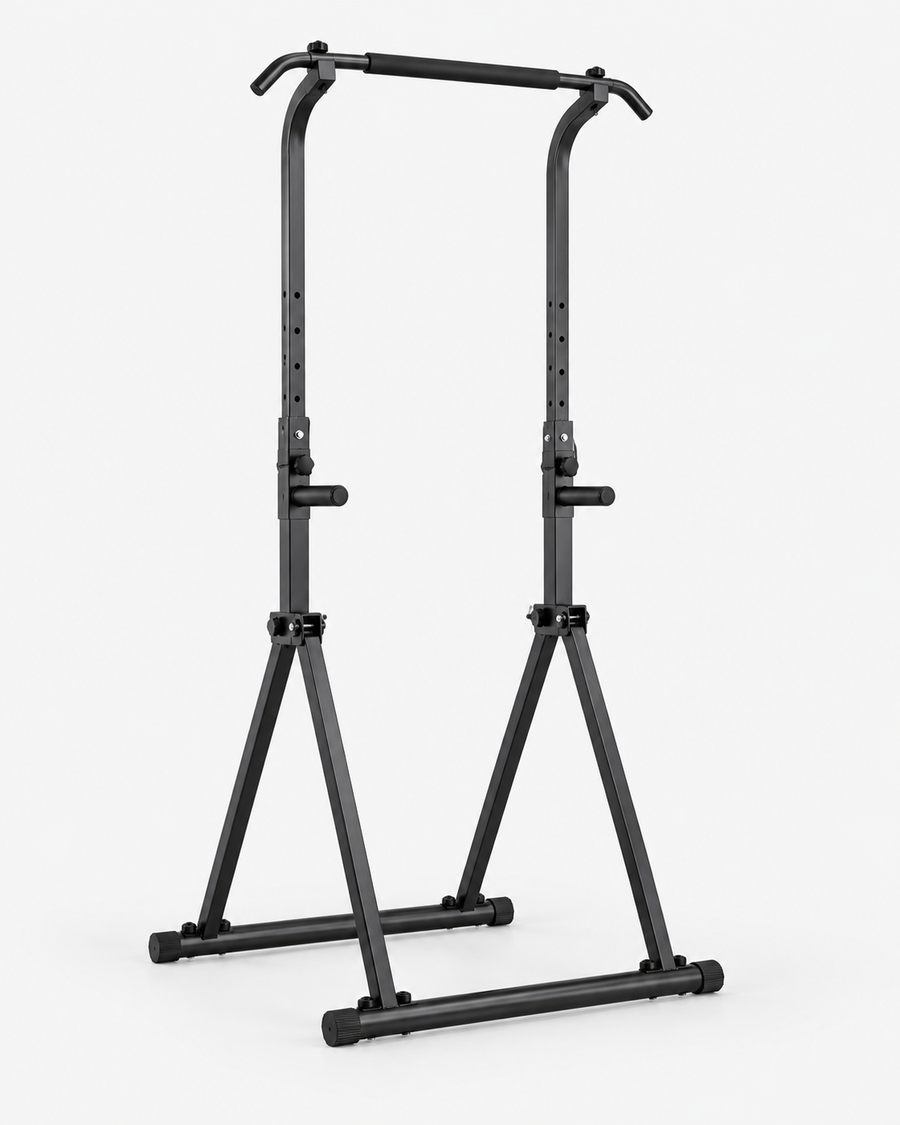

Dip Bars
Foldable Power Tower for Pull Ups and Dips
150 kg168 to 214 cm, 8 positions95 × 95 cm
118,90 €


Pull Up Bars
Wall Mounted Pull Up Bar with Dip Station, 200 kg
200 kgThick-walled steel, black finishNon-slip textured foam
141,90 €


Dip Bars
Adjustable Pull Up and Dip Station, 150 kg
150 kg165 to 219 cm, 10 positionsReinforced steel, 1.2 mm thick
121,90 €


Dip Bars
Adjustable Dip Bars, 200 kg
200 kg80 to 93.5 cm, 4 positions5 positions
90,90 €
The bars must stay still for the whole set. Look at the width of the base, the quality of the feet and whether there are non-slip pads. Place them on a flat, hard floor. If they move when you get on them, don't start the set.
Bars with adjustable height and width fit your height and shoulder width. A width close to shoulder width suits most people. The height should let you lower yourself without your feet touching the floor.
Dip bars also work for the L-sit, Australian pull-ups and knee raises. A pull-up and dip station adds a pull-up bar on the same frame. Choose based on the exercises you want to do in one spot.
Separate bars can be put away after your session. A pull-up and dip station takes up more floor space, but it folds away if the model is foldable. Measure the space you have, in width and height, before choosing between the two. Leave room in front and behind to swing your legs, too.
Choose dip bars if you mainly want to do dips and be able to put your equipment away. Choose a power tower if you also want to do pull-ups on the same frame, with no drilling. It takes up more space, but it replaces two pieces of equipment. Both stand on the floor.
Start with a width close to your shoulder width. Too wide and you load your shoulders; too narrow and your elbows run out of room. If your bars are adjustable, adjust them until your forearms stay vertical at the bottom of the movement.
Dips, of course, but also the L-sit, supported knee raises, Australian pull-ups under the bars and incline push-ups. With practice, you can add load with a dip belt. It's one of the most useful pieces of equipment for pushing work.
Start with the support hold, arms straight, for a few seconds. Then add slow negatives, using your feet on the floor to push back up. Once you control the way down, move on to full reps. A resistance band hooked over the bars can also help you at this stage.
It works at a pinch, but it's rarely stable. Chairs can slide or tip, and their height limits your range of motion. Dip bars that stand on the floor are designed for this movement: more stable, adjustable and easy to put away after your session.
Message me and I'll reply personally.


