Your cart
Your cart is empty
Start with the essentials for training at home.
Best sellers
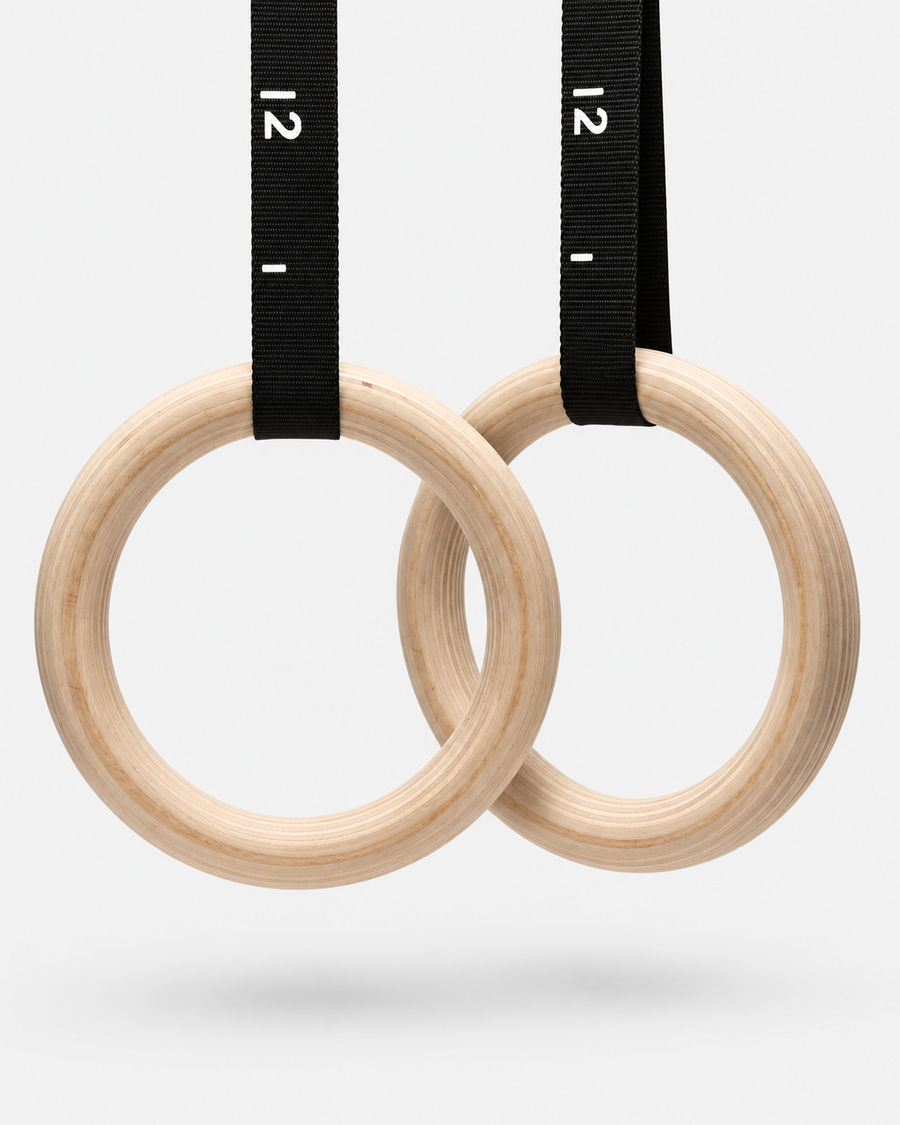
Gymnastic rings hang from a pull-up bar, a beam or a branch and almost replace a whole gym: pull-ups, dips, push-ups, ring rows, muscle-ups, front lever.
Wood gives a more natural grip than plastic and holds better when your hands sweat. Our rings are birch, with a smooth two-coat finish.
28 mm is the thinnest grip: easier for small hands and for learning the false grip. 32 mm is a thicker grip, close to a pull-up bar.
They have to be long enough to go around your support and set the height. Ours are 5.1 m long and 38 mm wide, with metal cam buckles.
Pull-up bar, beam or sturdy branch: the support has to hold your weight while you move. The manufacturer's stated strength for our rings is over 400 kg. Step-by-step setup is in how to set up your rings.
Wood gives a more natural grip and holds better when your hands sweat. That's why we chose birch rings.
28 mm if you've got small hands or you're working on the false grip. 32 mm if you want a grip close to a pull-up bar.
To a pull-up bar, a beam or a sturdy branch. The strap goes around the support, then through the cam buckle. It's all explained in how to set up gymnastic rings.
Pull-ups, dips, push-ups, rows, muscle-ups and the front lever. For the muscle-up, follow our full progression.
Yes. Start with ring rows and ring push-ups, then move on to pull-ups and dips. Their instability takes more control than a fixed bar, and works your shoulders on every rep.
Message me and I'll reply personally.