The dip is the most complete pushing movement in calisthenics: supported on two bars, you lower and raise your whole bodyweight. Here are the technique, the muscles worked, the variations by level and the equipment you need.
The technique in 5 points
- Hands: bars a little wider than your shoulders, 55 to 60 cm.
- The start: arms straight, shoulders down, away from your ears.
- The descent: two seconds, elbows pointing backwards, close to your body.
- The bottom: your shoulders reach elbow height. No lower.
- The push back up: push until your arms are straight, without swinging your legs.
Common mistakeHalf reps. A dip that stops halfway down doesn't count, and it prepares you for neither added weight nor the muscle-up. Five full dips are better than twelve halves.
The muscles worked
Dips work the triceps, the chest and the front of the shoulders. The position of your torso decides which one works hardest.
Pick one position and stick to it: it's the only way to measure your progress from one session to the next.
Variations by level
To get started
- Dips with feet on the floor. Low bars, feet down: your legs help you just as much as needed. Reduce the assistance from one session to the next.
- Negative dips. Get to the top position with a small jump, then lower yourself on your own, over five seconds. It's the lowering phase that builds strength.
- Band-assisted dips. A resistance band stretched between the bars, under your knees, carries part of your weight through the whole movement.
- Bench dips. Hands on a bench behind you, feet on the floor. Easy to set up, but they pull the shoulder backwards: keep them as an extra, not as your main exercise.
The step-by-step progression, with the thresholds for each stage, is in dips for beginners.
To progress
- Parallel bar dips. The reference version. Aim for 3 sets of 8 to 12 clean reps before looking for something harder.
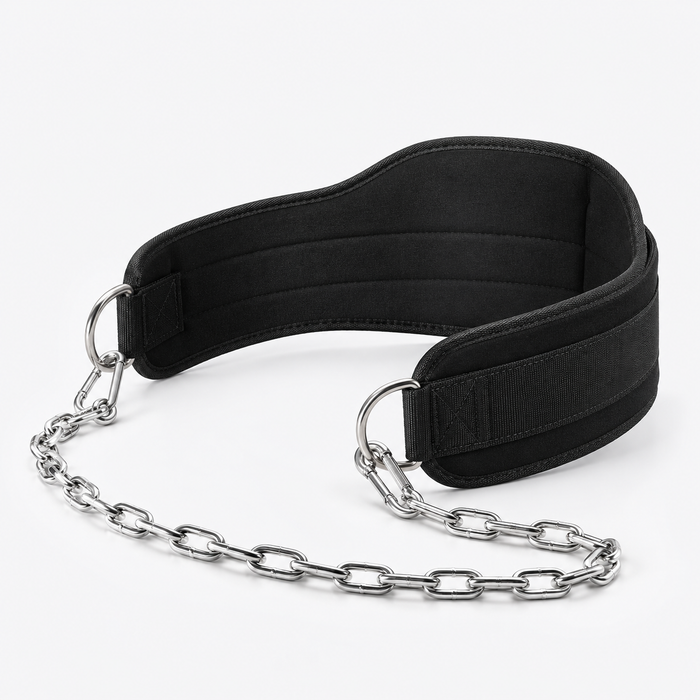
- Weighted dips. From 12 to 15 clean dips, a dip belt brings you back to short, heavy sets. It's all in weighted dips: technique, loads and progression.
- Ring dips. Rings move: every rep requires you to stabilise them. First hold a straight-arm support for 30 seconds before lowering into a dip. See how to set up gymnastic rings.
To go further
- Straight bar dips. Both hands on a single bar, in front of you. It's the second half of the muscle-up: work on it before going for your first muscle-up.
- Korean dips. The bar is behind you. This variation demands a lot of shoulder mobility: keep it for advanced athletes.
TipBefore adding weight or moving to rings, slow down. Three seconds on the way down and a pause at the bottom make the same dips noticeably harder, without changing anything else.
What to do your dips on
| Equipment | What it lets you do | Good to know |
|---|---|---|
| Adjustable dip bars | Dips, weighted dips, inverted rows, L-sit | Often adjustable in height and width, no drilling |
| Pull-up and dip station or power tower | Dips and pull-ups on the same frame | Free-standing, often rated for 150 kg. Allow one square metre. |
| Gymnastic rings | Ring dips, once you can do ten dips on bars | They need a solid hanging point |
Mistakes to avoid
- Shoulders rising towards your ears. Push the bars down before each rep.
- Elbows flaring out. They stay close to your body.
- Going too low. Past elbow height, it's the front of your shoulder that takes the strain.
- Bouncing at the bottom. Lower slowly and pause.
- Swinging legs. Cross your ankles and squeeze your abs.
Pain at the front of the shoulder or in the sternum ends the session. Start again with less range of motion and a slower descent.
 Mentioned in this guide
Adjustable Dip Bars, 200 kg200 kg · 80 to 93.5 cm, 4 positions · 5 positions90,90 €
View product
View product