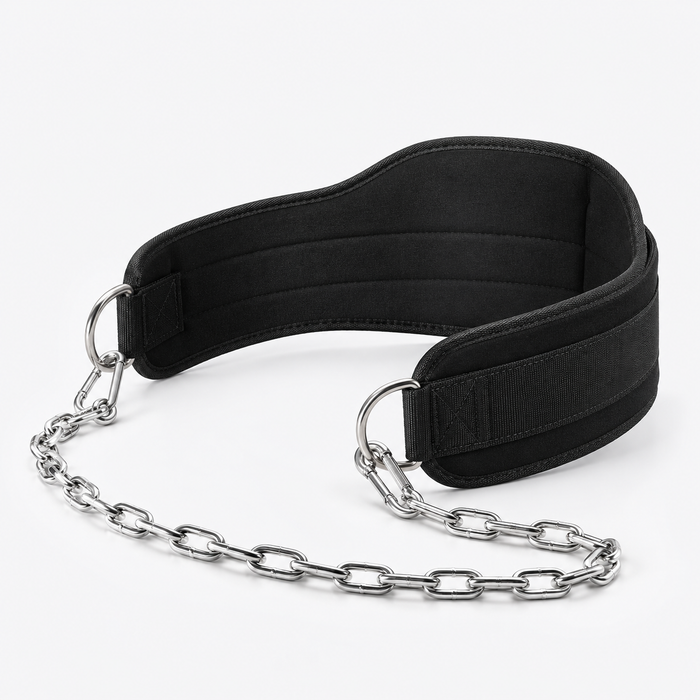
You can do clean pull-ups in a row and long sets aren't making you progress any more? Added weight is the next step. It makes every rep harder without changing the movement you've already mastered.
Why add weight to your pull-ups
With bodyweight alone, you end up adding reps without getting stronger. Added weight gets you progressing again: it builds strength in your back, biceps and forearms, and it prepares you for movements that need power, such as the muscle-up.
When to start weighted pull-ups
Wait until you're comfortable with your bodyweight. The benchmark: 8 to 10 strict pull-ups over 3 sets, chin over the bar, straight arms at the bottom, no swinging your legs. If you're not there yet, stick to bodyweight.
Common mistakeAdding weight too early. If your range of motion gets shorter as soon as you add 2.5 kg, go back to bodyweight.
How to carry the weight
| Option | Best for | Downside |
|---|---|---|
| Dip belt | Heavy loads, progressing in small steps | You need plates or a kettlebell |
| Weighted vest | Starting out, moving between pull-ups, push-ups and dips | Slower to adjust between sets |
| Dumbbell between the feet | Making do without equipment | Unstable, light loads only |
| Backpack | Making do without equipment | Weight on your back, unbalanced movement |
For long-term progression, a dip belt is a simple option: thread the chain through a plate and choose your load. Our neoprene dip belt with chain holds plates or a kettlebell. Weighted vests with pockets are another option. Our model is sold empty: fill it with steel plates or sand. The load is not included with the vest.
To decide, read weighted vest or dip belt, then how to choose a dip belt.
What weight to start with
Start at 5 to 10% of your bodyweight. It's not much, and that's on purpose: you need to keep exactly the same technique as with your bodyweight.
| Your weight | Starting weight |
|---|---|
| 60 kg | 3 to 6 kg |
| 75 kg | 4 to 7.5 kg |
| 90 kg | 4.5 to 9 kg |
For your very first session, stay at the bottom of the range: 2.5 to 5 kg is enough. If your range of motion gets shorter or you swing, the weight is too heavy.
The method: double progression
You keep the same weight and increase the reps first. When you reach the top of the range, you add a step and start again from the bottom.
- Do 4 sets of 4 reps with your starting weight.
- From one session to the next, aim for 5, then 6 reps per set.
- When your 4 sets of 6 are clean, add 1 to 2.5 kg.
- Start again at 4 reps with the new weight.
TipSmall steps always win. Better 1 kg more and clean sets than 5 kg and a cut-short range of motion.
Your typical session
- Warm-up: 2 sets of 5 bodyweight pull-ups.
- Weighted sets: 4 sets of 4 to 6 reps, 2 to 3 minutes' rest.
- End of session: 1 to 2 bodyweight sets, keeping 2 reps in reserve.
Do one or two weighted sessions a week, 48 to 72 hours apart. The rest of the time, train with your bodyweight.
6-week weighted pull-up programme
Prefer a ready-made plan? This programme takes two sessions a week, with at least two rest days in between. It combines weighted pull-ups and weighted dips: if you only do pull-ups, ignore the dips column.
Choose a starting weight that lets you do 6 clean pull-ups without swinging, and keep it for the first two weeks. Do the same for dips.
| Weeks | Weighted pull-ups | Weighted dips | Weight |
|---|---|---|---|
| 1 and 2 | 4 sets of 5 | 4 sets of 6 | Starting weight |
| 3 and 4 | 5 sets of 4 | 5 sets of 5 | One step more |
| 5 | 5 sets of 5 | 5 sets of 5 | Same weight |
| 6 | 3 sets of 5 | 3 sets of 5 | Starting weight, to recover |
- Rest 2 to 3 minutes between sets.
- Only add the week 3 step if all your sets in weeks 1 and 2 were clean.
- In week 5, if a set starts to break down, stop it: quality matters more than numbers.
- Finish each session with 2 sets of bodyweight pull-ups, keeping 2 reps in reserve.
The sixth week is a light week: your body recovers, and you start a new cycle with a slightly heavier starting weight.
Mistakes to avoid
- Adding weight too fast. One step every fortnight is plenty.
- Shortening the range of motion. Straight arms at the bottom, chin over the bar, on every rep.
- Swinging. Added weight doesn't forgive swinging: it pulls on your shoulders.
- Letting your core go. Brace your abs so the weight doesn't swing.
- Training heavy too often. Without recovery, strength doesn't go up.
What to do when you plateau
- Take a light week. Halve the weight, keep the technique.
- Go back to longer sets. Two to three weeks of sets of 6 to 8, with less weight, often get you progressing again.
- Make your steps smaller. Go to 1 kg at a time.
Safety: your bar and your equipment
- Your bar must take your bodyweight plus the added weight, with a margin. For weighted work, choose a securely fixed wall-mounted bar, like an offset bar with brackets. The guide on how to choose a pull-up bar covers the criteria.
- Before every session, check the belt, the chain and the carabiners.
- Get on the bar without swinging, using a step if the weight is heavy.
- Always put the weight on the floor before taking off the belt.
- Joint pain isn't fatigue: stop the session.
And weighted dips
The same belt works for dips, on adjustable dip bars. The benchmarks are the same: wait until you can do 12 to 15 clean bodyweight dips, start with a light weight, then progress in steps.